The Dawn of Machine Calculation
300 Years of Computing: From Pascal to Zuse
Long before relays, before vacuum tubes, and centuries before transistors, the idea of a machine that could calculate was taking shape. The journey from the first mechanical calculators of the 1600s to the relay computers of the 1940s is a story of slow, steady evolution. Each generation of machines solved a different piece of the puzzle —user interaction, programmability, precision, speed, and reliability.
Early Mechanical Calculators: The First Steps Towards Computers
The story begins in 1623 with Wilhelm Schickard, a German astronomer who built what is now recognized as the first mechanical calculator. His “Calculating Clock” used gears and rotating drums to add and subtract, and it assisted Johannes Kepler with astronomical tables. Although Schickard’s machine was lost to history for centuries, it introduced a crucial idea: arithmetic could be mechanized.
Two decades later, in 1642, Blaise Pascal (French) created the Pascaline, a robust adding machine built from precision gears and carry mechanisms. Unlike Schickard’s device, Pascal’s machines survived, were manufactured in quantity, and were demonstrated widely.
He designed the machine to add and subtract two numbers and to perform multiplication and division through repeated addition or subtraction. The Pascaline could handle between 5 and 10 digits, depending on the specific model.

The Pascaline: 6-digits, CNAM Museum, Paris
Early Mechanical Calculators: The First Steps Towards Computers
The next major leap came from Gottfried Wilhelm Leibniz in 1672 (Germany). His Stepped Reckoner introduced the stepped drum (later known as the Leibniz wheel), a mechanical innovation that allowed a machine to multiply and divide automatically. Leibniz also articulated a deeper vision: reasoning could be reduced to mechanical operations.
His ideas included Boolean logic concepts and digital computation 175 years before George Boole’s work. Important too was the binary work of English scientist Thomas Harriot (1560-1621), before Leibniz.
Leibniz’ machine was the first calculator capable of performing all four basic arithmetic operations—addition, subtraction, multiplication, and division. In 1923, the Deutsches Museum, Germany, commissioned a fully functional reconstruction based on Leibniz’s surviving drawings and descriptions. The machine has an 8-digit input section and a 16-digit accumulator (where the results appeared). Historical drawings also show that a 12-digit version may have existed.

Replica of Leibniz's stepped reckoner in the Deutsches Museum, Germany
Of note; Leibniz proposed a different machine (he never built it) that worked only in binary. It used rolling marbles, gates and registers to perform arithmetic using base-2. See Binary calculator using marbles for an excellent video based on Leibniz’ concepts.
These early machines were limited, slow, and delicate, but they established the essential principle that calculation could be performed by a machine following deterministic rules.
[Ifrah]
Industrial‑Era Calculators: Scaling Up Computation
One of the most famous machines developed was the Difference Engine (DE) by Charles Babbage in the 1820s. This was an automatic mechanical calculator engineered to tabulate polynomial functions using intricate gears and the method of finite differences. Although manufacturing limitations and funding disputes prevented completion during Babbage's lifetime, modern reconstructions have proven his visionary design was perfectly functional.
Every level of its operation—from its internal state representation to its arithmetic logic and error-correction mechanisms—operated entirely on discrete, integer states (specifically decimal, base-10).

Replica Difference Engine No.2, designed by Charles Babbage,
Science Museum, London, completed June 1991
By the 1800s and early 1900s, mechanical calculators had become industrial tools. Companies like Burroughs, Monroe, and Marchant built rugged, crank‑driven machines capable of handling business arithmetic. These devices were faster and more reliable, but they were still fundamentally mechanical: gears, cams, levers, locks, and springs.
They computed, but they could not decide. They lacked programmability, conditional logic, and the ability to store and manipulate symbolic information. The conceptual leap from “calculator” to “computer” required a new kind of switching element—something that could represent binary states (0,1), switch rapidly, and be wired into arbitrary logical structures.
[Williams]
The Relay: The First True Digital Logic Element
Edward Davy (English, 1806-1885) built an “electric relay” to repeat telegraph signals. Davy invented the relay to “renew the current” on long-distance telegraph lines and to steer telegraph signals to different endpoints. Telephone switching systems likewise relied on relays to steer signals and make logical decisions based on the number dialed.
By the early 20th century, telephone exchanges used millions of electromechanical relays to route calls. Relay characteristics:
-
Two states (binary): 1/0, true/false, on/off, high/low, +volts/0_volts, per contact pair
-
Capable of moving several contact arms to independently switch circuits
-
Electrically controlled – a digital switch with many practical contact arrangements
-
Capable of implementing logic (AND, OR, XOR, NOT gates)
-
Capable of storing logic state
-
Reliable and mass produced
Western Electric Company produced about 100 million relays between 1920 to 1948 for exchange switching. So they knew more about relay manufacturing and reliability than anyone.
View this short video (one contact pair) to get a feel for relay operations.

The Big Three Switches
The relay was the first switch but what about the vacuum tube (1906) and transistor (1948)? All three can change state from 0/1 or 1/0. However, a single relay can support many linked contact forms (on/off, off/on, form-C, and more) per device and can do far more logic work than one vacuum tube or one transistor. However, tubes and transistors can do more 0/1 switching work per second. See The History of the Telephone Relay for more insights.
The first machine to compute using vacuum tubes was Atanasoff and Berry (the ABC, in 1942). Other tube-based systems followed, for example: the Colossus (Tommy Flowers at Bletchley Park, UK, 1943) and the ENIAC (1945). One version of a full 1-bit binary adder uses 9 Triode tubes for the gate switching whereas the same function can be done using only 2 multi-contact relays. More on this later.
In 1954, Bell Labs built the TRADIC (TRAnsistor DIgital Computer) and it was the first computing machine to eliminate vacuum tubes and relays. In 2026, for a single, monolithic die, ~104 billion transistors (about 26 billion logic gates) is the state of the art. This is a component in the NVIDIA/TSMC Blackwell B200, a data‑center AI GPU.
Famously, the transistor was invented at Bell Labs (AT&T). It should be no surprise that telephone engineers were looking for a relay replacement (something faster, smaller, and more reliable). After all, "Necessity is the mother of invention". A trio of Bell scientists John Bardeen, Walter Brattain, and William Shockley invented the transistor in December of 1947. All three received the Nobel Prize in Physics in 1956.
The First Binary Adder using Relays
George Stibitz (mathematician at Bell Labs) is recognized as the father of the binary adder using relays. In his kitchen in 1937 he built the Model K relay adder (using two telephone exchange relays) with two input switches, A and B (0 and 1 inputs), and 2 outputs Sum and Carry_out (lamps). This was the first relay-based binary adder, albeit very rudimentary.
Of note, his concept model was only a “half adder”. This means that there was no “Carry_in” terminal only and A and B keys. Two of these adders can be easily combined to make a “full adder” with 3 inputs and 2 outputs. Check out an interactive adder demo here (based on Boolean logic gates).
Keep In mind that the relay was invented 100 years earlier and it took a PhD mathematician to conceive of 2 relays doing binary math. This seems obvious today but was a gigantic intellectual leap in 1937. See Endnote A.
This experiment started a fire at AT&T, and Stibitz was effectively the “chief engineer” on the Model I to Model VI relay calculators/computers over the next many years (discussed below).

Model K, 1-bit binary adder by Stibitz (Computer History Museum)
Konrad Zuse and the First Relay Computers
In the 1930s, German engineer Konrad Zuse (with colleague Helmut Schreye) recognized that relays could be wired into networks that performed logical operations. He built a series of groundbreaking machines:
-
Z1 (1936) – all mechanical logic/memory, proof of concept, unreliable
-
Z2 (1939) – hybrid design, 600 relays for the ALU but using mechanical memory
-
Z3 (1941) – fully relay‑based, ~2,600 relays, 22-bit floating‑point arithmetic, program on punched film. The 22 bits were split as: 14 mantissa, 7 exponent, 1 sign.
The Z1/Z2 designs were powered by an electric motor. Through a system of cams, direction-changer levers, and pushrods located in the "basement" (lower layer) of the machine, rotational motor motion was converted into horizontal and vertical reciprocating motion. The machines used binary logic gates and were implemented with flat, sliding sheet-metal plates, pins, and guide slots. Very clever!
The Z3 is widely regarded as the first working, programmable, digital computer. It proved that relays could implement not just arithmetic but general computation. Interestingly, it did not support a dedicated conditional branch instruction (If this, then jump there) yet is regarded as a computer by most experts. Computer scientist Raúl Rojas (1998) proved that the Z3 is theoretically Turing-complete, hence a computer not just a calculator [ Rojas]. There have been 4 major reconstructions of the original Z3.
The Z3 1-bit full relay adder (5 relays) was not based on Stibitz design but a variation with some possible help from Helmut Schreye. See Endnote B.
In his autobiography, The Computer – My Life (1993), Zuse said, "A relay computer doesn't just calculate; it works. It has a rhythm, a cadence, and when hundreds of relays flip in harmony, you can hear the logic happening."
The three Figures below show the Zuse Z3, all-relay computer.

Zuse Z3 replica on display at Deutsches Museum in Munich

The image above is from a 2016 article by Horst Zuse, son of Konrad Zuse. Note the blazing clock speed of 5.33 Hz. https://www.zuse.de

Other Relay-based Machines
The years 1940–1947 were the golden age of electromechanical machines. A calculator executes a fixed sequence of operations to evaluate mathematical expressions, whereas a computer uses conditional branching to dynamically alter its own execution path based on intermediate data.
About the same time as Zuse, Bell Labs employees (George Stibitz and Sam Williams took the lead working with 20 other engineers) began building relay calculators then relay computers. Below are some notable models. The Model I was not programmable in the same fashion as the Zuse Z3, they are in different categories.
-
Bell Labs Model I Complex Number Calculator (1940) – 450 relays and eight, 100-point, crossbar switches for memory
-
8 decimal places of precision, used a modified form of BCD arithmetic.
-
-
Bell Labs Model II, Relay Calculator (1943)
-
493 relays, crossbar memory, operational until 1961
-
-
Bell Labs Model V Computer (1944) – 9,000 relays
-
Harvard’s Model II Computer (1947) – Fully relay based with approximately 13,000 high-speed relays. Built by IBM as a partner.
-
10 digit floating point numbers, 8 additions per second
-
The only mechanical parts were the peripheral input/output devices
-
These models demonstrated that relay computers could be scaled, maintained, and operated reliably for long periods. All Bell Labs models were constructed with “telephone relays” designed by Bell Labs and manufactured by Western Electric Co, both subsidiaries of AT&T [Williams, pg 224] .
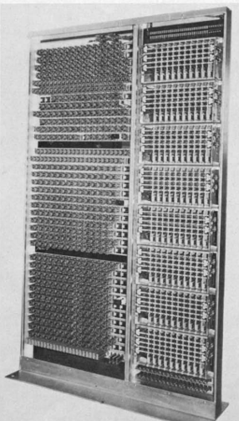
Bell Labs Complex Number Calculator, Model Mark I, 1940
Photo archive, Lucent Technologies
The Bridge to Electronic Computing
Relay computers were slow by modern standards (about 5 to 15 additions per second) but they were the first machines to embody the full architecture of digital computers.
Relay logic provided the conceptual blueprint that vacuum tubes, transistors, and integrated circuits would later accelerate by many orders of magnitude. Can Artificial Intelligence (AI) be implemented using only electromechanical relays? Check out a discussion on this here and the history of the relay here.
Conclusion: A 300‑Year Journey to the First Computers
From Pascal’s wheels to Babbage’s DE, to Stibitz’ K1 relay adder, to the Zuse Z3, the evolution of computing was a slow accumulation of breakthrough ideas:
-
Mechanizing arithmetic
-
Represent information symbolically
-
Implement logic using electro-magnetics
-
Store and manipulate state
-
Build programmable systems
The relay was the first true digital switch. A device that leapfrogged centuries of mechanical ingenuity and helped launch the dawn of the computer age.
For more information related to these topics including a list of DIY relay computers, check out the TOC pages from the main menu above.
Endnotes
A: Relay math was not completely foreign to Stibitz. He worked for Bell Labs (AT&T) and was certainly aware of how relays were used to count dial pulses from a caller. The Panel telephone exchange had a wonderful example of a relay-based digit counter using a so-called 1/2/4/5/Z code (1927). It wasn’t binary but a step in the right direction. See Fig 9 in the companion website Calling315.com for a description of how this worked.
B. The original Z3 (destroyed in December of 1943, WW2) used 5 relays for each full adder circuit, or 6 with a "sum" relay output. The 1961 Z3 reconstruction by Konrad Zuse uses a 2 relay 1-bit full adder. Both the 5 and 2 relay circuits are described by [Zuse] , page 198.
References
Ifrah, Georges. The Universal History of Computing: From the Abacus to the Quantum Computer. Wiley, 2001.
Rojas, R., How to make Zuse's Z3 a universal computer, IEEE Annals of the History of Computing ( Volume: 20, Issue: 3, July-Sept. 1998)
Williams, Michael R. A History of Computing Technology. 2nd ed., IEEE Computer Society Press, 1997.
Zuse, Konrad. The Computer – My Life. Springer, 1993.